Some of the most recognizable guitar and bass sounds of the last 50 years have one thing in common: diode clipping.
It is one of the basic technologies behind classic overdrive and distortion pedals, from the DOD 250 and MXR Distortion+ to the Tube Screamer and RAT. The circuits may be very different, but they all use nonlinear clipping to turn a clean or amplified signal into something more harmonically rich, compressed and aggressive.
And in 2026, diode clipping is still everywhere. Not because it is old technology, but because it sounds good and responds well to playing.
What Does Diode Clipping Actually Do?
For a musician, this can mean:
When a signal gets pushed beyond a certain level, the diode limits its peaks. The waveform changes shape, producing additional harmonics and reducing the difference between loud peaks and quieter parts of the signal.
- more harmonic character
- more sustain
- stronger pick attack
- natural-feeling compression
- increased density
- more bite and aggression
Not Just “More Gain”
Diode-clipping effect can change the character of an instrument without simply making it louder.
With moderate clipping guitar can become more responsive and expressive. Hit the strings harder and the distortion becomes more apparent. Play softly and more of the original character remains.
This is also why overdrive pedals are often used before an amplifier rather than instead of an amplifier. A moderate amount of clipping can push an amp or amp simulator harder, changing the way the entire distortion chain responds.
Clipping Type Matters
Not all clipping sounds the same. Symmetrical and asymmetrical clipping produce different harmonic structures. Different diode types also have different thresholds and nonlinear responses.
The result can range from smooth and compressed to open, bright, aggressive or heavily distorted.
This is one reason pedal builders have spent decades experimenting with different clipping arrangements.
The circuit may look simple, but the way it clips is a major part of its personality.
Guitar: From Breakup to Distortion

For guitar, diode clipping can cover a huge range.
A small amount can add just enough grit to a clean amp.
Used before a distorted amp, it can tighten the response and make the sound more focused.
This makes it useful for everything from blues and classic rock to alternative, punk, metal and modern high-gain production.
Bass: Add Harmonics, Keep the Weight

Bass presents a slightly different challenge.
Heavy distortion can make a bass sound exciting on headphones but disappear on smaller speakers because the fundamental becomes harder to hear.
Controlled clipping can help solve that problem.
Instead of relying entirely on the fundamental frequency, distortion creates additional harmonics that make the bass easier to hear in a dense mix.
A little clipping can add definition and growl.
More can turn distortion into a major part of the bass sound.
Filtering becomes especially useful here, allowing you to control how much low end and high-frequency content enters and leaves the clipping stage.
Why It Still Works
Modern production gives musicians countless ways to create distortion: amp modeling, saturation, wave shaping, convolution and sophisticated nonlinear processing.
But the musical goal hasn’t changed. Sometimes you don’t need another complicated distortion algorithm.
You need the guitar to bite a little harder.
You need the bass to speak through the mix.
You need a clean part to start breaking up when you play harder.
Or you need an already distorted tone to become more aggressive and alive.
DioDrive
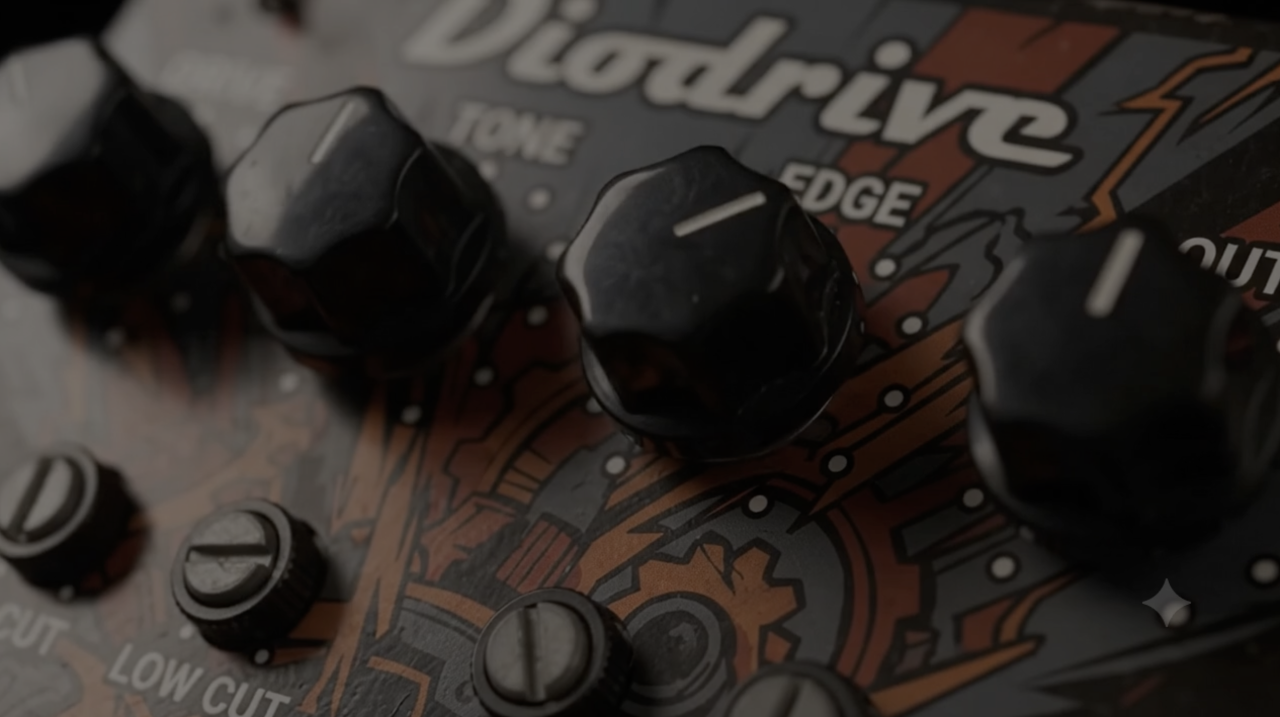
DioDrive plugin takes this classic idea and puts it into a modern guitar and bass effect plugin.
The focus is not on reproducing one particular vintage pedal. It is on using diode-style clipping as a flexible distortion tool.

With Drive, you control how hard the signal is pushed.
Edge lets you move the clipping character toward a more aggressive response.
Trim Drive provides another way to push the effect and becomes especially interesting together with Edge.
Tone, Low Cut and Hi Cut help shape what the clipping does to the frequency spectrum, while PAD gives additional control when working with hotter signals.
The result can be anything from solid, responsive overdrive to much more aggressive distortion.
A Lot of Range
Diode clipping is a good example of why some classic audio technologies never really disappear.
The principle is simple. The possibilities are not.
For guitar and bass, clipping can add harmonics, compression, sustain, attack and aggression—and it can do it in a way that still reacts to the way you play.That’s why, decades after the first classic clipping pedals appeared, diode clipping is still a useful sound-design tool in 2026.
Leave a Reply